Content Disclaimer: This article contains speculative theories presented for entertainment. Readers are encouraged to form their own conclusions.
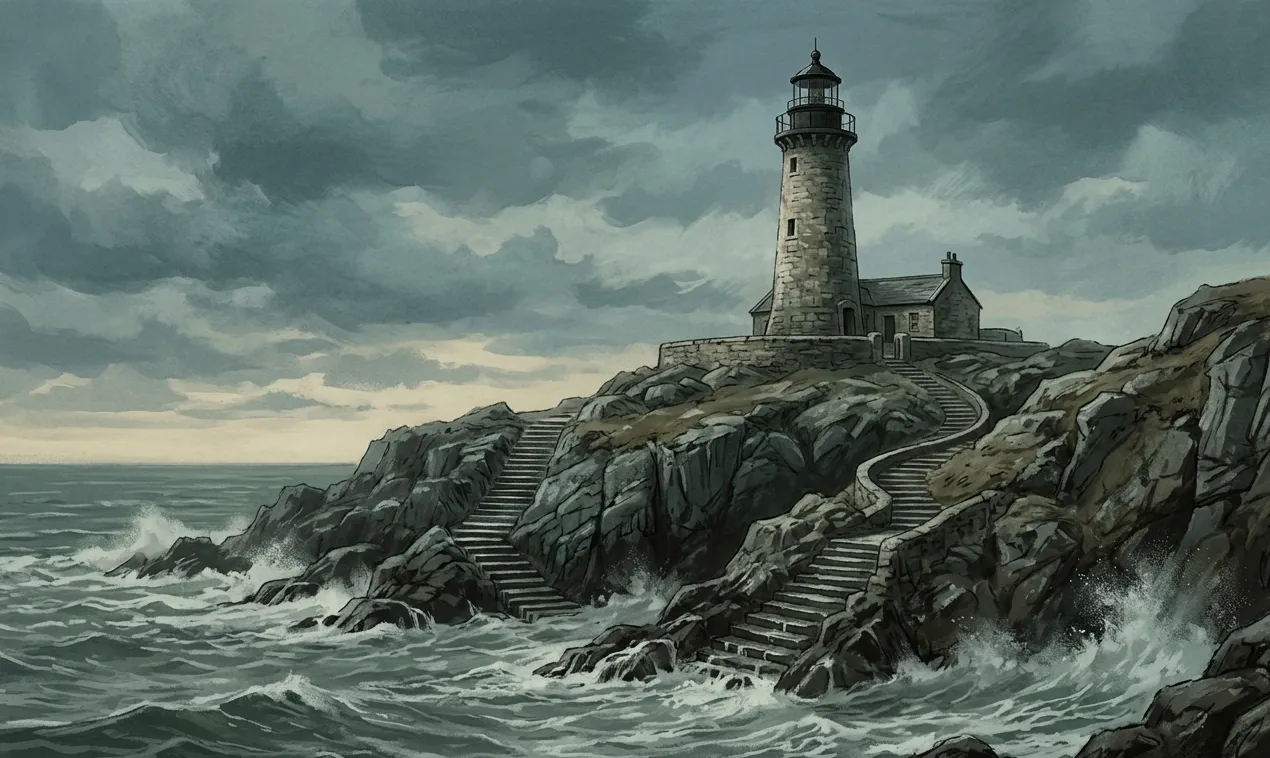
On the evening of December 15, 1900, the steamer Archtor passed through the waters near the Flannan Isles, a scattering of uninhabited rocks jutting from the Atlantic about twenty miles west of the Isle of Lewis in Scotland's Outer Hebrides. The ship's captain glanced toward Eilean Mor, the largest of the seven islands, where a newly built lighthouse was supposed to be casting its beam across one of the most dangerous stretches of ocean in the British Isles. The light was dark.
He logged the observation and sailed on. Nobody acted on it for eleven days.
It was not until December 26, Boxing Day, that the relief vessel Hesperus finally reached the island. The ship had been scheduled to arrive earlier, but rough seas kept it at port. When it finally anchored off Eilean Mor, the crew noticed something wrong immediately. There was no one at the landing platform to greet them. No flag flying from the flagstaff. No provision boxes set out for collection. The island sat silent.
Joseph Moore, the relief keeper, climbed the steep steps cut into the cliff face and made his way to the lighthouse compound. The entrance gate and the main door were both closed. Inside, the clock on the wall had stopped. The fire in the grate was cold, long dead. Two of the three sets of oilskins and waterproof boots were missing from their hooks. The third set, belonging to Donald MacArthur, the occasional keeper, still hung in its place. The beds were unmade. On the kitchen table sat an untouched meal, a chair overturned on the floor as if someone had risen in a hurry.
Moore went back to the cliff edge and signaled the Hesperus. "No keepers found," he reported. The ship's crew came ashore to help search the island, but Eilean Mor is small, barely a quarter mile across. There was nowhere to hide and nowhere to go. Thomas Marshall, James Ducat, and Donald MacArthur were simply gone.
The three men were experienced. Ducat, the principal keeper, was a veteran of twenty years with the Northern Lighthouse Board. Marshall, the second assistant, was younger but competent and well regarded. MacArthur was a local man, familiar with the sea and the fierce weather of the Outer Hebrides. These were not reckless men. They understood the dangers of the rock they lived on.
The lighthouse on Eilean Mor had only been operational for a year. It was a prestige project for the Northern Lighthouse Board, designed by David Alan Stevenson, cousin of the novelist Robert Louis Stevenson, whose family had built most of Scotland's lighthouses over the preceding century. The Flannan Isles light was meant to make the waters between Lewis and the open Atlantic safer for the growing volume of shipping traffic. Instead, it became the site of one of the most baffling disappearances in maritime history.
Superintendent Robert Muirhead arrived on December 29 to conduct the official investigation. He examined the lighthouse logs, which had been meticulously kept until December 15. The final entries, written by Marshall, described a severe storm battering the island on December 12, 13, and 14. He noted that Ducat had been "very quiet" and that MacArthur had been crying. This was strange. Ducat was known as a stoic, steady man. MacArthur, a seasoned islander, was not the type to weep over rough weather.
But here is where the story fractures into uncertainty. Meteorological records from the surrounding area showed no storm on those dates. The weather station on the Isle of Lewis, just twenty miles away, recorded calm conditions on December 12 through 14. The storm Marshall described in the logs does not appear to have happened, at least not according to any other observer in the region.
Muirhead inspected the western landing platform and found significant damage. Iron railings were bent and twisted. A heavy storage box, bolted into the rock at a height of over thirty meters above sea level, had been ripped from its fastenings and smashed. Ropes and equipment were tangled and displaced. Something powerful had struck the west side of the island, though whether it was a rogue wave, a localized squall, or something else entirely remains a matter of debate.
The official conclusion, delivered carefully, was that the three men had gone to the west landing to secure equipment during a sudden storm and were swept away by a massive wave. It was a tidy explanation. It also left several uncomfortable questions unanswered. Why would MacArthur leave without his oilskins in December, in the Outer Hebrides, where the wind could kill you with cold? Why was the door closed and latched behind them? Lighthouse protocol dictated that at least one keeper must remain inside at all times. All three leaving together would have been a serious breach of regulations, one that men of their experience would not take lightly.
The Flannan Isles lighthouse continued operating, staffed by keepers who reportedly found the posting eerie and unsettling. Relief keepers spoke of hearing voices in the wind, of an oppressive atmosphere that seemed to press down on the island, particularly during storms. Whether this was grief, superstition, or something more, the lighthouse earned a reputation that it never shook.
In 1971, the light was automated. No one has lived on Eilean Mor since.
Related Articles